INFORMATION TO REQUEST ARTIST STAND
Artist House, Non-Commercial and Zone +18
In this section you will find all the necessary information for setting up an artist booth at Japan Weekend. Please read the regulations and FAQs carefully. If you have any questions, complaints, suggestions, or other inquiries, we recommend filling out the form you will find in this section. The English version will be available soon.
The Art website will open for new registrations in the spring of 2027.
To set up an Artist House, Non-Commercial, or +18 booth at Japan Weekend, you must be registered on the Arte website (https://arte.japanweekend.com/) and have obtained your artist identification code.
IF YOU ARE AN ARTIST HOUSE MEMBER AND ALREADY HAVE AN ACTIVE ARTIST IDENTIFICATION CODE, YOU DO NOT NEED TO REGISTER AGAIN. ONLY THOSE WHO DO NOT HAVE AN ARTIST IDENTIFICATION CODE, OR NON-COMMERCIAL ARTISTS WHO BELIEVE THEIR PORTFOLIO qualifies them to become ARTIST HOUSE MEMBERS, NEED TO REGISTER. More information is available in the FAQ and the regulations.
Process and operation
What is the purpose and function of the Japan Weekend Artist Zone?
The Artists’ Zone was created with the aim of offering a space specifically dedicated to artistic creation within Japan Weekend. It is not just a sales area, but an environment designed to foster the visibility, growth, and professionalization of artists within the sector.
We want it to be a place where the public can meet the creators of the works directly, understand their process, and support original work.
Within this area there are two modalities:
Artist House
Artist House is designed for artists with a consolidated artistic level. Selection is made through a qualitative evaluation of the portfolio, taking into account aspects such as technical quality, coherence of the proposal, artistic development, and overall presentation.
The goal is for them to be able to showcase their work as the central focus of their stand, reinforcing their artistic identity and facilitating direct contact with their audience.
Non-Commercial
The Non-Commercial modality is aimed at artists who are growing or beginning to participate in events. Its purpose is to facilitate access to professional experience, allow for practical learning, and support the progressive development of their artistic proposal.
Both modalities are part of the same creative ecosystem. They don’t compete with each other: they fulfill different functions within the same area and seek to promote talent at different stages.
The Artists’ Zone is not a typical commercial area. It is a subsidized zone whose main objective is to support artistic creation and its exhibition within the event.
What is the difference between a commercial booth and an artist booth? Can I apply for a commercial booth if I am an artist?
The difference is due to the price, type of area, and materials included in each option.
In both the Non-Commercial, +18, and Artist House areas, the stand includes two chairs and the inclusion of the stand’s name in the area’s promotional posts on our social media. This promotion is exclusively for artists participating in the Artists’ Zone and the +18 Zone. Commercial stands or activities outside of this zone are requested to refrain from using or presenting themselves as part of this promotion.
In the Non-Commercial and +18 sections, a table of approximately 2 meters is provided. In the Artist House section, a metal structure with walls and two L-shaped tables of approximately 2 meters each is included, which implies a higher structural cost within the venue.
In comparison, a stand in the commercial area has a considerably higher cost per square meter and does not include furniture such as tables or chairs.
The Artists’ Zone is a subsidized space. The amount paid by an artist does not cover the actual cost of the floor or other expenses associated with the event, such as venue usage, cleaning, general lighting, assembly and dismantling of structures, and other services necessary for the operation of the pavilion.
The reduced price of the Artists’ Zone reflects its purpose: to offer an accessible space for exhibiting original artwork. The commercial zone, on the other hand, is intended for shops and operates under a different model, both in terms of regulations and cost structure.
If an artist wishes to work under a model closer to a retail setting, with greater freedom of display or more space, they can request information by writing to comercial@japanweekend.com to find out the rates for the event they are interested in. Additionally, a stand in the retail area can be shared among several artists.
If I'm an artist over 18, can I request a booth?
Yes.
The +18 area is intended for artists whose work includes adult content and, by its nature, requires exhibition in a space separate from the rest of the event. Its objective is to allow these types of artistic proposals to be displayed and sold within a suitable environment and with the necessary measures to protect minors.
Artists in the +18 Zone are part of the same creative ecosystem as the rest of the Artists Zone and are subject to the same general regulations, except for specific exceptions related to the type of content that is allowed to be displayed in this space.
I am a literary author, can I apply for an artist booth?
If your proposal consists exclusively of selling books, it does not belong in the Artists’ Zone.
Authors who only present literary works must request space in Mangatown or in the Creators Zone, which are the areas of the event designated for that type of format.
The Artists’ Zone is primarily focused on the exhibition of visual artwork and its development in physical format within the stand.
However, if in addition to your books you present your own artwork that complies with the area’s regulations (for example, illustration or another visual format developed by you), it is possible to request a stand in the Artists’ Zone, provided that the overall proposal remains consistent with the space’s objective.
In that case, books can be part of the stand’s materials, but not its sole content.
How does selection work in Artist House?
Selection for Artist House is based on an evaluation of the portfolio submitted by each artist.
We know that art is subjective and that any assessment can generate doubt. Our goal is not to establish a hierarchy among artists, but to manage a limited space, trying to maintain a balanced area with solid artistic proposals.
At some events, we may receive over a thousand applications for fewer than one hundred spaces. When demand exceeds the number of available booths, we must prioritize applications based on the artistic quality of the portfolio and the coherence of the proposal presented.
If two artists apply for a booth together, the evaluation is carried out taking into account the entire booth.
Can you summarize the process for requesting a stand?
The complete process is carried out in several phases:
- Read the regulations and the FAQ. Before applying for a stand, you must check that the material you wish to sell meets the requirements established in the stand regulations.
- Request your artist code. You must request your Japan Weekend artist ID through the art website. This code is personal and non-transferable and confirms that your portfolio has been reviewed by the art team. With it, you are classified into one of the groups (NOCOM, AH, or +18) and can request a booth at the events.
- Wait for the opening of registration for the event you wish to apply to, which will be announced on JW_Arte’s Twitter/X.
- Fill out the Registration Form; you have a sample at the bottom of the page. Incomplete or incorrect applications will be automatically cancelled.
- After a few days, you will receive an email indicating your status (place confirmed, waiting list, migration, or application cancelled).
- If you are awarded a place, you must pay for the stand using the link provided.
- Once you have paid for the stand, you must fill out the additional information form.
- A few days before the event you will receive another email with your location, a map of the area, the setup and takedown schedule, and the information needed to participate.
- During the event, it is the artist’s responsibility to ensure that all exhibited material complies with the regulations and is consistent with the material reviewed in the portfolio.
- Deposit refund. If the stand complies with regulations, the deposit will be refunded after the event. Payments are made on the 10th and 25th of each month and may take approximately a few weeks, with a maximum period of two months as per regulations.
Is having an artist code mandatory? How does it work?
Yes. To register in the Artists’ Zone, you must have an active artist identification code..
This code is obtained through the official Japan Weekend art website during the designated period, which usually opens in spring and is announced on our social media. Without this code, it is not possible to complete the Registration Form.
The code does not guarantee a place in a specific event, but it does enable the artist to register for calls for proposals that open after the evaluation period.
Is the code permanent?
Yes, the code remains active indefinitely unless it is withdrawn for non-compliance with regulations. If you already have an active code, you do not need to request it again or repeat the application process.
The only situation in which the code is modified is when an artist requests and obtains the upgrade from Non-Commercial to Artist House. In that case, the previous code is replaced with the new one.
Code may be removed if there is a breach of regulations.
Can I upgrade from Non-Commercial to Artist House?
Yes. Artists with an active code can request access to Artist House when the corresponding process opens, by submitting the application for that modality.
If the Artist House code is granted, the Non-Commercial code is automatically removed, as it is not possible to keep both active at the same time.
It is important to note that if Artist House was not obtained in the previous year’s evaluation, the result will likely be similar unless there has been a significant evolution in the artistic proposal.
Therefore, we recommend conducting an honest assessment of your own level, coherence, and artistic development before requesting a change of modality. Self-criticism helps ensure a coherent and efficient process for everyone.
Applying for Artist House doesn’t imply a penalty if you don’t get it, but we do advise doing so when there is a solid basis that justifies the change in modality.
You removed my code for violating the rules in an event. Can I request it again?
It depends on the case.
In certain situations, after a one-off breach, the code may be requested again in future calls for applications.
However, in cases of serious or repeated breaches, withdrawal may be permanent.
Each situation is assessed individually based on the severity of the events and the individual’s prior history.
What is a Sales Portfolio and what should it include?
The “Sales Portfolio” is the folder where you compile the material you plan to bring to the event. It is not a general art portfolio or a collection of past work, but rather a representative sample of the specific products that will be for sale at your stand.
Since the Artists’ Zone has specific regulations, especially regarding original creations, copyright, and product distribution, the portfolio allows us to conduct a preliminary review and identify potential issues before the event. In the case of Artist House, it also helps us evaluate the complete proposal, as social media doesn’t always clearly reflect the merchandise or physical items that will be sold.
What should it include?
The portfolio should contain 70% of the material that will be taken to the event. This allows us to have an overview of the stand, although there may be a small percentage of products not initially included.
Photographs of previous booths should also be included, if available, whether from Japan Weekend or other events. This helps us evaluate the presentation and layout of the materials.
If including photographs of previous booths, these must reflect a layout that complies with Japan Weekend regulations.
If you don’t have photos of previous stands, you can include a simulation or mock-up of how you would set up your table for the event, taking into account the layout regulations.
Furthermore, it is mandatory to include at least one valid process for each product type, as indicated in the regulations.
Is it mandatory to show the hands in the process or timelapse?
It is not mandatory to show your hands, although it may be requested later.
What is mandatory is that the process clearly shows the complete development from the blank canvas to the final line art, without cuts, time jumps, or incorporating elements already drawn outside of that same process. It can be shown in time-lapse to make it shorter.
In case of doubt, if the process cannot be adequately verified, the portfolio may be rejected. This requirement is applied generally to ensure that everyone receives equal treatment and that the public can be confident they are acquiring original artwork.
If you have been asked to complete this type of process in previous reviews, or if you believe your material may raise questions during the review, we recommend including a video showing the hands during the process to expedite the portfolio evaluation.
Does it have to be on Drive? How should it be organized?
Yes. The portfolio must be hosted in a single public Google Drive folder.
Subfolders are not allowed. All content must consist of individual files in .jpg or .png format, directly within the same main folder to facilitate review. Process videos can be uploaded in .mp4 format. Links to other platforms or nested folders will not be accepted.
If this structure is not followed or the portfolio does not include the required process, the application will be rejected without further review.
Due to the high volume of requests we receive during each review process, we cannot request manual access to locked folders or wait for permissions to be corrected. If we cannot access the portfolio content at the time of review, the evaluation will be rejected.
Unifying the format and structure allows us to review all applications more efficiently and fairly.
What happens if I’m going to bring products that aren’t finished yet?
If you have products in development that are already underway and that you plan to bring to the event, you can include sketches or images of the process in the folder, along with an explanatory document indicating what final product will be offered for sale.
If, after confirmation of your stand, you significantly change the materials you will be bringing, you must update your portfolio and notify us by email.
When requesting a stand, why are there two forms?
The process is divided into two forms for organizational and efficiency reasons.
The Registration Form is used exclusively to request a place and determine the registration order. At this stage, only the essential information needed to validate the application is requested.
The Additional Information Form is only sent to those who have been selected and have paid for their stand. It collects the necessary administrative information for the event: invoicing, deposit refunds, accreditations, and other logistical details.
This system allows us to:
- Speed up initial registration.
- Do not request sensitive or administrative information from people who will ultimately not obtain a place.
- Reduce errors and unnecessary modifications.
- Facilitate the modification of certain stand data, such as accompanying persons or other administrative information, within the established deadlines.
The fact that there are two forms does not imply greater complexity, but rather a phased organization of the process.
What information do we ask for in the forms?
In the Registration Form we only request the data necessary to validate the application and determine the order of registration. This data allows us to verify the artist’s identity, their compatibility with the art website, and the requested modality (Artist House or Non-Commercial).
As a new feature, and with the aim of ensuring that all artists have the same opportunities to obtain a spot based on registration time, if a shared stand is requested, only the second artist’s email address will be required. This email address must be the same one used to register on the art website.
In this way, we aim to make the time required to complete the form as equal as possible between those registering individually and those registering with another artist.
The form must be completed only by the artist responsible for the stand. The second artist does not need to submit a separate registration.
Once the spot has been confirmed and the stand payment has been made, the full details of the second artist must be included in the Additional Information Form.
It is the responsibility of the lead artist to ensure that the second artist has the correct identification code for the requested booth type.Otherwise, the booth will be automatically cancelled without the possibility of participating in that event.
In the Additional Information Form, which is only received by selected individuals after paying for the stand, the essential administrative data for the proper management of the event is requested, such as:
- Information related to the stand (name and icon).
- Social networks of artists.
- Billing.
- Return of the deposit.
- Accreditations.
We do not ask for unnecessary information. Each piece of data requested corresponds to a specific need within the event organization process.
Before registering, you can consult the test form available on this page to get an idea of the type of questions included in the actual form.
What happens if I've entered incorrect information?
It depends on which form the error occurred in.
The application is cancelled in the Registration Form
The Registration Form determines the validity of the application and the order of registration.
If the information is incorrect, incomplete, or does not match the profile of the art website, the application will be cancelled in accordance with the regulations.
Since the registration period is limited and the order is crucial, it is each person’s responsibility to carefully review the information before submitting it.
You can modify it in the Additional Information Form
This form remains open and editable until the organization has used this data for purposes such as accreditations, listings, or billing.
When we close the possibility of modifications, you will be notified by email indicating the date and time limit. Once closed, no changes can be made, except in cases of force majeure duly accredited (for example, with medical or legal documentation).
It is important to carefully review the information before submitting the form and, once submitted, to check and update the data if necessary before the event to avoid subsequent problems.
If you need to modify any data, do not create a second record. You must access the original record and make the modification on that same form.
In case of duplicate registrations, which one is taken into account?
If multiple registrations are submitted for the same event, only the last one registered within the registration period will be considered.
Duplicate registrations do not grant priority or improve the position in the registration order.
Whenever possible, it is preferable to avoid duplicates and carefully review the information before submitting your application.
What happens if I apply for an Artist House stand and don't get a spot?
If you apply for an Artist House (AH) stand and do not obtain a place in thisthis category, your application will automatically migrate to the Non-Commercial category, provided you meet the requirements to participate in that area.
This migration is done automatically during the selection process so you don’t have to register a second time.
If you ultimately do not wish to participate in the Non-Commercial category, simply do not pay for the stand if you are offered a space in that area.
On the other hand, if a space becomes available in Artist House later and you want to switch from NC to AH, that would also be possible. If two artists originally applied to share a booth in AH and, after not receiving a space, moved to two NC booths, you could return to sharing a booth in AH, as stated in the initial application.
In that case, it would be necessary to pay the amount corresponding to the AH stand and, subsequently, when the deposit refunds are processed, the amount already paid by NC will also be refunded, if that migration had occurred previously.
How long is the registration period open for an event?
Registration for each event is open for 6 calendar days, unless the organizers specify a different period.
Once this period has ended, the form closes automatically and it is not possible to register after the deadline. Late registrations and applications by mail are not accepted.
Opening dates are announced in advance on our social media. The link to the application form is provided on the opening day and posted on the official X de JW_Arte account.
Since the order of registration is important, we recommend having all the necessary information and the link to your Sales Portfolio ready in advance before the form opens.
The registration period will not be extended except in exceptional technical circumstances.
How and when will I know the result of my application?
Once the registration period has ended, we review all applications received.
When the review process is complete, each registered person receives an email indicating their status. This may be:
- Place confirmed at Artist House.
- Place confirmed in Non-Commercial.
- Waiting list (Artist House or Non-Commercial).
- Request not assigned.
- Application cancelled due to incorrect data or failure to meet requirements.
The result is always communicated by email. We also usually announce it on our official art Twitter account/X on the same day the emails are sent.
It is important to check your spam folder and verify that the address provided in the form is correct.
In the case of Artist House, if a space is not obtained in that category, the application will automatically be migrated to Non-Commercial. If the artist does not wish to use this category, they simply need not pay for the stand.
Your place is only considered confirmed when you receive the confirmation email and pay for the stand within the indicated deadline.
You rejected my portfolio and didn't give me a reason / you're not responding to my reply
We understand that receiving a rejection can be frustrating, especially when you’ve dedicated time and effort to preparing your portfolio.
However, due to the volume of applications we receive in each call for proposals, we cannot offer an individualized assessment or a detailed report to each artist who does not obtain a place.
A portfolio may not be accepted for various reasons: non-compliance with regulations, not being in the required format, absence of the mandatory process, lack of sufficient material for the event, or simply because the level or proposal does not fit within the available quota at that time.
At Artist House, selection also depends on a qualitative assessment.
Not responding to a reply does not imply disinterest or arbitrariness, but rather a matter of operational capacity. It is not feasible to individually review each disagreement or open personalized debate processes.
We recommend carefully reviewing the regulations, comparing your portfolio with those of other artists in the area, and, if you deem it appropriate, requesting feedback from colleagues in the industry to further improve your proposal.
Rejection in a particular cycle does not mean you cannot be selected in the future.
You've taken away my deposit and I don't think it's fair
The deposit is linked to compliance with the regulations and the conditions of the stand during the event.
When a deposit is withheld, it is not done arbitrarily or for revenue-raising purposes, but as a consequence of a detected breach. The purpose of the deposit is to guarantee that the rules are respected and that the area functions in an orderly and equitable manner for all artists.
We know it can be annoying or frustrating, but applying the regulations consistently means doing so in all applicable cases.
In situations of serious or repeated non-compliance, in addition to the loss of the deposit, the artist code may be withdrawn.
Our goal is not to punish, but to maintain a level playing field within an area with limited spaces. The rules are the same for all participants.
Why do you say I'm violating the regulations if you supposedly reviewed my portfolio?
Portfolio review is a pre-assessment tool, but it does not replace the in-person review of the booth during the event.
In the portfolio, we request that 70% of the material to be taken to the event be included. This means that there may be a percentage of products not included in that initial review. If this remaining material does not comply with the regulations, it may be noted at the event itself.
In addition, some portfolios contain hundreds of files. Although the team performs a careful review, when the volume is very high, the evaluation can be done at a general level. In such cases, a specific piece may not be detected in the first review.
It’s also important to keep in mind that we work with a huge variety of styles, references, and IPs. It’s not possible to know absolutely every existing series, video game, or original material. Sometimes, a potential redraw, tracing, or excessive similarity may not be detected in the first review and only become apparent later, either in a more detailed review or after receiving additional information.
On the other hand, as a general rule, the portfolio shows the products individually, but not how they will be physically arranged on the table or what proportion each type of material will occupy. There are items that, individually, comply with the regulations, but whose quantity or prominence in the stand can disrupt the required balance.
The review is carried out by a team, and the final application of the regulations is assessed on the entire stand once it is assembled. The on-site inspection is what determines compliance in its actual form.
Therefore, the fact that something has not been previously indicated in the portfolio does not imply that it is automatically authorized.
What happens if I share a stand and there's a violation of the regulations?
When a booth is shared by two artists, both are responsible for the content displayed. However, for administrative purposes, the artist responsible for the booth is financially liable for any potential breaches.
If a violation of the regulations occurs, the deposit will be managed through the artist responsible for the stand.
Regarding the artist code, consequences will be applied on a case-by-case basis. If the breach clearly pertains to the material or performance of only one of the two artists, the code may be withdrawn from that individual only.
However, since they share a space, both must ensure that the entire stand complies with regulations. Responsibility for the overall consistency of the space is shared.
I want the billing to be done in the name of a family member, group, or similar. How should I do this?
Invoicing must always be done in the name of the artist responsible for the stand or the brand/entity directly linked to that artist.
We do not issue invoices to family members or third parties unrelated to the stand.
The data used to issue the invoice is taken exclusively from the billing information section of the Additional Information Form. In that section, you must indicate the full name as it appears on your ID card or corresponding legal document, as this is the data that will be used to issue the invoice.
In the artist details sections, however, you must indicate the name by which the artist wishes to be identified during the event. This will be the name that appears on accreditations, lists, and communications related to the booth. Therefore, the name visible during the event can be different from the legal name used for billing.
As a trans person and a booth manager, where do I provide my legal name for billing?
If you are the person responsible for the stand and your ID card is not up to date, you must provide your legal name only in the corresponding section of the Additional Information Form, in the billing information section.
This name will be used exclusively for issuing the invoice and for mandatory administrative procedures.
On accreditation and documentation visible during the event, the name you indicated in the “artist name” section will be used, in accordance with the regulations.
It is important to ensure that the legal information provided for billing purposes is correct, as it cannot be modified once the administrative phase has closed.
General Questions
Is having a stand at Japan Weekend for me?
Having a stand at a large event can be a very positive experience, but it also involves a significant investment of time, money, and preparation. Before registering, we recommend considering whether it’s the right time for you.
Participating in an event of this size is not a requirement to be an artist, nor a mandatory stage in a creative journey. Many people develop their artistic work for years without participating in events, or do so only at specific points in their career.
In addition to the cost of the stand, it’s important to consider other associated expenses: material production, transportation, accommodation, food during the event, and preparation time. All of this can represent a considerable investment, especially if you have to travel from another city.
If you’re just starting out, it can be a good idea to begin by participating in smaller events or those closer to your area, where the number of artists is lower and logistical costs are reduced. This allows you to gain experience, test what kind of materials work best, and learn to manage a booth with less financial pressure.
It’s also important to remember that hundreds of artists participate in large events like Japan Weekend. Competition is high, and results can vary greatly from one booth to another.
Setting up a booth can be a very enriching experience if you’re prepared for it, but it’s not an obligation nor a measure of the value of your work as an artist. Our advice is to carefully consider the moment, your goals, and your situation before taking the plunge.
Why are booth prices going up? What influences the price change?
The price of the stands depends largely on the external costs of the event.
Venue rental, pavilion-related services, structure assembly, cleaning, electricity, and other overhead costs can vary from year to year. When these costs increase significantly, the organizers must partially adjust prices to maintain the event’s financial stability.
In the Artists’ Zone, we try to minimize the impact of these price increases. Since it is a subsidized space, we absorb a significant portion of the actual cost of the land and associated services.
Furthermore, in order to keep prices down, we have built our own structures for the Artists’ Zone. If we were to use external rental systems for this type of setup, the cost of the stand would be considerably higher for participants.
However, when there is a general increase in the costs of the venue or mandatory services, it may be necessary to adjust the price of the stands.
Each edition is evaluated independently, and any modifications are based on structural factors, not arbitrary changes.
Do we decide what is art and what is not?
No.
We don’t decide what is and isn’t art. Art is broad, diverse, and deeply subjective. There are countless valid forms of expression, and just because something doesn’t fit within our Artists Zone doesn’t mean it isn’t art or that it lacks value.
What we do is manage a specific space within an event with limited capacity, limited resources, and a specific model. To be able to do this, we need to establish regulations and criteria that allow us to maintain consistency, balance, and a clear identity for the area.
Our criteria do not determine the artistic value of a work, but rather whether it fits within the format and objectives of this specific area.
It is possible that a style, product type, or artistic approach may not conform to our current guidelines. This does not invalidate or delegitimize the work. It simply means that it may not correspond to the Artist Zone model we have defined for Japan Weekend.
We try to make decisions as fair as possible within a context where there will always be more demand than available space.
What type of material usually works best at events?
There is no single formula that works for everyone.
Each artist has a different style, a different audience, and their own way of presenting their work. Some booths work better with large illustrations, others with small products, and others with combinations of both.
It is most common for artists to experiment during several events to discover what material connects best with the audience and what format best suits their artistic vision.
It’s also important to keep in mind that audiences can vary greatly between cities and events, so something that works well in one place may perform differently in another.
Some artists publicly share information about their experiences at events, conduct surveys, or even talk about suppliers and distributors. There are also communities and support networks among artists where advice and experiences are exchanged. However, it’s important to remember that for many people this is their main professional activity, so they are not obligated to share their data, figures, or contacts.
Why are you limiting a type of product if it's the one that sells the most at my stand?
We know that many specific products can be the most profitable at a booth. We also understand that nobody sets up a booth just for the love of it: attending an event involves an investment of time and money, and it’s only natural to want to recoup that investment.
However, the Artists’ Zone is not a typical commercial area. In fact, the generic stands are called non-commercial stands for a reason. It is a subsidized area whose main objective is to support the exhibition and dissemination of original artwork, not to function as an unrestricted sales space.
Our regulations are not designed to maximize sales, but to preserve the area’s identity. If we allowed the most commercially viable or easily profitable products to occupy most of the space, the area would eventually lose its essence, and the difference between it and the commercial zone, which is the area designated for shops, would become blurred.
That’s why in some cases we don’t prohibit certain products, but we do limit them. We seek a balance: that you can sell and that the event is viable for you, but that the central focus of the stand remains your artwork.
If an artist wishes to sell without these types of limitations or focus their activity primarily on a more commercial format, there are other options within the event:
- Commercial stand, where the regulations are different.
- Creators Zone, designed to help you connect with and sell to your followers in a short period of time, while also allowing you to enjoy the event.
- Manga Town, designed for literary authors, comic book creators, or publishers, where the main material for sale must be printed works (books, comics, fanzines, or other publications). Promotional merchandise related to these works, such as t-shirts or other related products, may be included as a complement, provided that the printed publication remains the main element of the stand.
It’s not about pushing anyone out of the artists’ area, but about explaining that each space in the event serves a different function.
Do you prohibit or limit the art of any franchise?
We don’t usually prohibit or limit any IP address in general.
If you have ever read from artists that we prohibit or limit a franchise, it is most likely a specific case where a particular piece violated the regulations, not a general policy regarding that intellectual property.
The most common cases are usually related to:
- Redraws or reproductions too close to the official material.
- Tracing or use of official images as a direct basis.
- Designs that could be confused with official merchandise.
- Use of logos or registered trademarks on product or packaging.
Our review is not based on the franchise itself, but on how the piece is made and whether it meets the criteria of original creation and differentiation from official material.
The fact that a work is based on a known IP address does not automatically mean it is prohibited. What we review is the process, originality, and compliance with regulations.
If a specific piece is not authorized, the decision is made individually and based on those criteria, not on its popularity or the brand it comes from.
Why do you limit chibis or simplified material?
Chibis and simplified styles are not prohibited.
Chibi art is a perfectly valid style within the artistic field. The limitation does not reflect a value judgment about the style nor is it intended to delegitimize it.
What is limited is its predominance within the stand.
The main objective of the Artists’ Zone is the exhibition of artwork. When a single format, especially one focused primarily on small-scale merchandising or quicker production, occupies most of the visible space, the zone loses diversity and becomes homogenized.
We are aware that complex chibis require time, technique, and development, and that not all simplified works are equivalent. However, the guidelines are based on a general pattern observed after reviewing thousands of portfolios and booths over the years.
Some artists may choose a more simplified style as an artistic decision. In these cases, the evaluation is based on the overall coherence and development of their proposal. However, the criteria for stand predominance and balance apply equally to all participants.
When we talk about limitations, we’re not just referring to the drawing style, but also to the type of product designed primarily as simplified merchandising. It’s allowed to be included, but it shouldn’t become the dominant feature of the stand.
In the case of Artist House, during the review we evaluate the artist’s entire body of work. We may consider their chibis, but the evaluation focuses primarily on what we understand as a complete body of work: non-simplified illustrations that reflect technical and artistic development. We don’t require complex backgrounds or mandatory color, but we do require a piece that demonstrates skill and coherence in the overall concept. This complete body of work is what unlocks the door to the Artist House level.
If, later at the event, the work for which the place was awarded is relegated to a filing cabinet or a secondary space while most of the table is occupied by simplified material or focused on small merchandising items, the proposal loses coherence with the initial assessment.
In the Non-Commercial section,the main objective is to encourage variety within the area. When an artist has only one table, whether because they are in the Non-Commercial section or because they share an Artist House, it becomes clearer if the space is composed almost exclusively of simplified products. We don’t limit fan art, we don’t prohibit specific IPs, nor do we require artists to work exclusively in print, but we do seek diversity and consistency between what is presented in the portfolio and what is displayed at the event.
The regulations aim to maintain the overall balance of the Artists’ Zone and ensure that the whole reflects varied and developed proposals.
Why do you limit apparel or products produced by third parties?
apparel or products manufactured by third parties are not prohibited.
What is limited is its predominance within the stand.
We understand apparel to be those products whose basic design belongs to the artist of the stand but whose manufacture has been carried out by third parties, such as certain garments, bags, caps, backpacks, jewelry, plush toys or other similar items.
The limitation responds to a matter of balance within the event.
Japan Weekend also features artisans who produce their pieces entirely from scratch, undertaking a completely manual process and incurring different production costs. If these types of externally manufactured products were allowed to occupy most of the booth in the Artists’ Zone without restriction, it would create an unequal situation within the event’s ecosystem.
This is not about questioning the legitimacy of designing and producing through third parties. It is a valid working model. However, the Artists’ Zone is primarily intended for the exhibition of direct artistic creation.
Therefore, the apparel is permitted, but it must occupy a minority portion of the visible space of the stand and not become the structural or predominant element.
The goal is to maintain the area’s coherence and protect the artisans who develop their work entirely from scratch.
How is the 1/3 stand limitation applied?
The following mock-up shows an approximate representation of how the 1/3 stand limitation established in the regulations is applied:
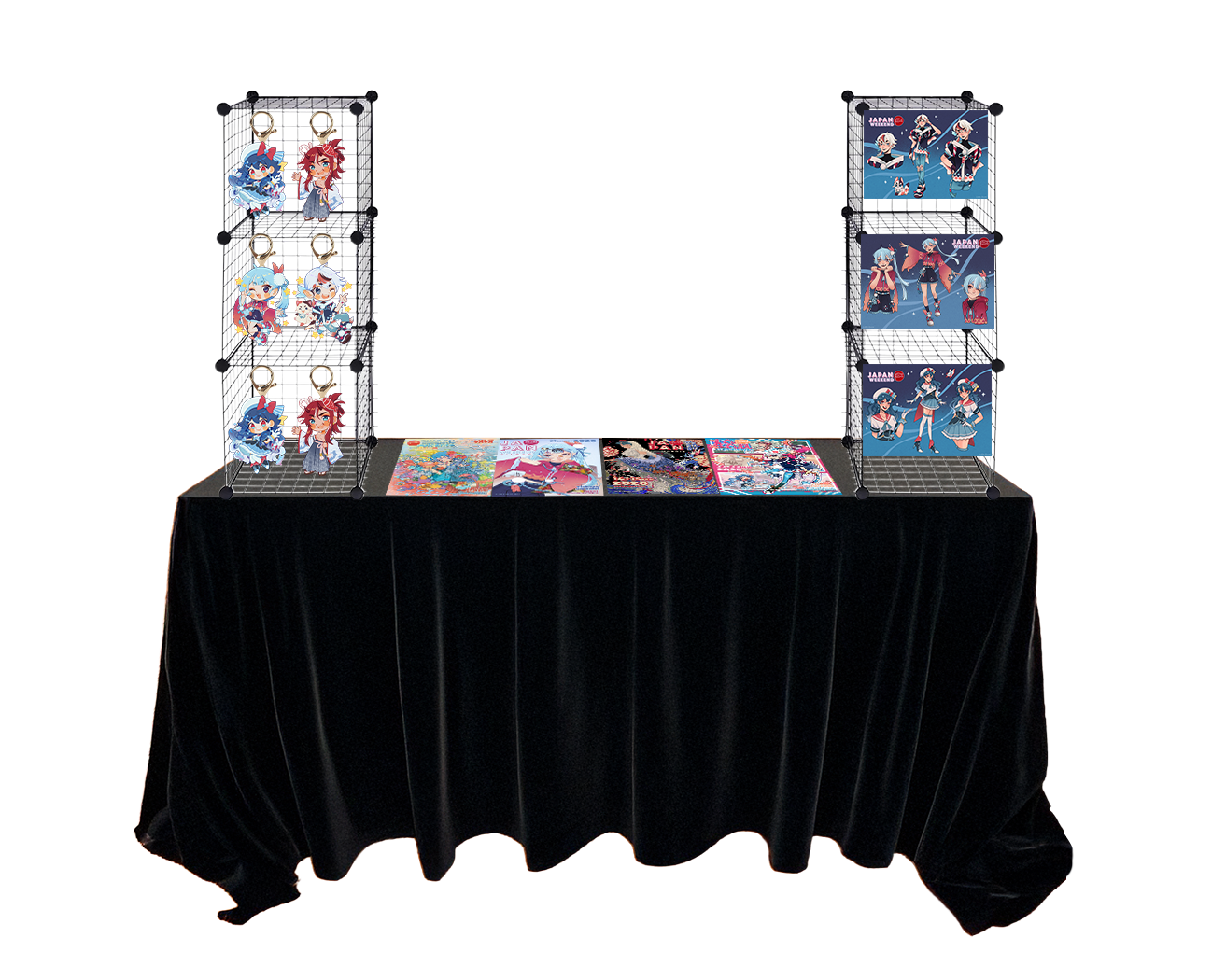
Because we cannot use photographs of other artists’ booths and can only use our own merchandise for the example, the mock-up shows less material than would appear in a real booth. For this reason, it should be understood as a minimal visual representation, created solely to help visualize the approximate proportion that corresponds to that third of the space.
This is not intended to reflect the total number of products a stand can have, but simply to illustrate the approximate proportion of the limitation.
In addition, a real-world stand may include other visible elements such as additional structures, displays, or artwork on the walls (for example, at Artist House). All these elements form part of the overall stand design, so the 1/3 ratio should be applied considering the total visual space.
Consequently, a real stand could have more units of certain products than those shown in this example, as long as the overall display still respects the approximate proportion established in the regulations.
Why are you asking us not to take the regulations out of context?
Because partial information can generate unnecessary conflicts within the community.
A recent example is the regulation of chibis and similar content. For years there has been a limitation on this type of product, which has been adjusted over time. However, when someone shares this rule in isolation and without the full context, it can convey the idea that “Japan Weekend prohibits chibis,” which is not true.
From there, debates, publications, and comments can arise that not only affect the organization but also other artists, even going so far as to question or attack their work.
For these types of situations, when it is detected that distorted information is being spread that causes conflict or misinformation, we can apply penalties.
Constructive criticism is welcome, and many parts of the regulations have evolved thanks to input from artists. All we ask is that, if discussed, it be done comprehensively and accurately, without inciting the audience to attack the organization or other artists.
Our goal is to avoid unnecessary confrontations and protect both the organization and the community itself.
I've been assigned an unfavorable spot during several events and I'm not selling anything
We understand that location can influence the perceived visibility of a stand.
However, experience shows us that there is no direct and guaranteed relationship between position and sales. We have seen artists in front-line positions with modest results, and artists in more distant positions with very good sales.
In the Non-Commercial category, placement is assigned in order of registration. In Artist House, selection is based on portfolio, but placement also takes into account the order of registration and organizational factors.
In some specific cases, especially when an artist has a large audience, we can adjust the location to prevent queues from affecting the other stands.
We try to make the distribution as balanced as possible within the limitations of the space. However, no event can guarantee specific financial results.
If after several editions you feel that the event doesn’t meet your objectives or isn’t profitable, there may be other events with fewer artists or a different format that are a better fit for you.
I saw the Japan Weekend staff at another event. I think they checked my booth.
We do not review stands at other events.
Our work and reviews are limited exclusively to Japan Weekend. We do not conduct external inspections or evaluations outside of our own events.
It’s important to remember that team members also have personal lives and may attend other events for leisure.
We ask that you refrain from heckling or questioning team members outside of Japan Weekend, whether at other events or on their personal social media. These types of situations are uncomfortable and intrusive.
If any harassment or confrontational behavior occurs towards the team, either within or outside the professional context of the event, we may take appropriate action.
I've had a problem with another artist. Can you intervene?
It depends on where and how it happened.
If the incident occurs within the event and is a serious situation or one that affects the normal course of events, you must notify the organizers immediately. There are always staff at the accreditation desk or security personnel who can intervene at that moment.
If the conflict occurs outside the event or on social media, we cannot mediate in situations unrelated to Japan Weekend.
Our scope of action is limited to the space and time of the event. Within that framework, we will act if necessary to guarantee a safe and respectful environment.
Outside of it, we have no authority to intervene in personal conflicts.
Can you prevent thefts at the event?
Event security includes personnel and protocols, but it’s important to understand that in spaces with large crowds, zero risk doesn’t exist.
If you detect a theft in the moment, immediately notify security or the organization. The faster the reaction, the greater the chances of intervention. In many cases, the perpetrators are minors, and when possible, their legal guardians are located to manage the situation and recover the stolen items.
However, the organizers cannot assume direct responsibility for the items on each stand. Therefore, we recommend taking preventative measures:
- Do not leave money unattended on the table or always carry it with you.
- Keep the material always visible.
- Avoid baskets or self-service systems.
- Secure small items, such as keychains, with strong fasteners like cable ties.
These measures considerably reduce the risk.
Our goal is for the area to be a safe space, but prevention by each stand is essential.
What facilities do you offer if I have accessibility or support needs?
For wheelchair users, we can try to provide more accessible locations within the overall layout of the space, provided that this is communicated well in advance via the Additional Information Form. Allocation will be subject to availability and the venue’s structure.
It is important to note that Japan Weekend is a very crowded event with ambient noise, music, and constant stimuli. We recommend considering this environment before applying if prolonged exposure to this type of space might be difficult for you.
Can someone who isn't accredited help me at the event?
Unaccredited individuals are not permitted to remain at the stand or participate in the setup, event, or dismantling.
Everyone who will access or remain in the stand must be properly accredited. If you need help, this must be indicated on the Additional Information Form within the established deadlines.
It is not possible to add companions or helpers outside of this procedure or during the event without prior accreditation.
The organization needs to know in advance which people will be inside the stand for reasons of capacity control, security, and internal management.
If an exceptional circumstance arises, you must communicate through official channels before the event to assess the situation.
ZONE REGULATIONS
It is very important that Please read the complete regulations before requesting an artist code
Questions, Complaints or Inquiries Box
If you believe that the regulations are being infringed (calquering, IA...) you can also fill out the following form
Test Form
You can access the test form to request a stand below
UPCOMING STAND APPLICATION OPENINGS
If you want to apply for an artist stand at Japan Weekend, pay attention to our website and social media
MADRID (September 26 and 27)
CLOSED
BILBAO (October 3)
CLOSED
VALENCIA (November 28 and 29)
Registration opens on 11 Agost at 11:30 am
ARTIST ALLEY, NON- COMMERCIAL y +18.
The links will be posted on @JW_Arte on the social media platform X